

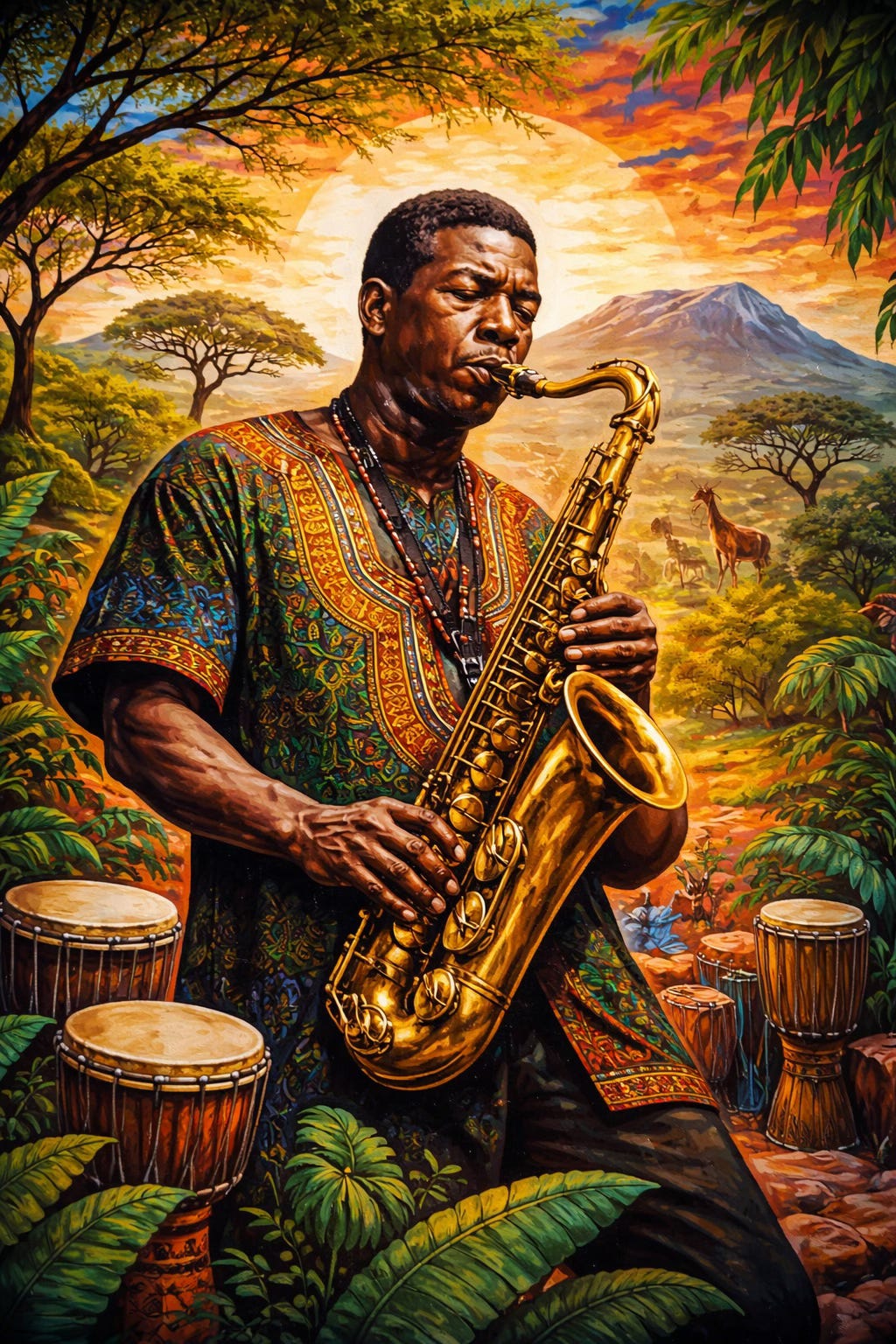
By May 1961, John Coltrane stood at a crucial juncture in his artistic development. He’d already revolutionized jazz saxophone through his work with Miles Davis, particularly on Kind of Blue, and had established his own quartet with McCoy Tyner, Jimmy Garrison, and Elvin Jones. His soprano saxophone work on “My Favorite Things” had become a surprise hit, introducing modal jazz to a wider audience through an unlikely vehicle, a Rodgers and Hammerstein show tune.
But Coltrane wasn’t content with commercial success or critical acclaim. He was obsessed with expanding his musical vocabulary, driven by deep spiritual and philosophical questions that he increasingly channeled through his horn. He’d been studying African music, Indian ragas, and various world music traditions. He was reading extensively about African history and culture, trying to reconnect with roots that slavery had severed. This wasn’t superficial exoticism. Coltrane was searching for something profound, trying to trace musical lineages back to their sources.
The decision to record with a large ensemble reflected multiple influences. Gil Evans had shown what could be done with orchestral jazz through his collaborations with Miles Davis. Charles Mingus was working with larger groups and African-influenced material. But Coltrane wanted something different, something more primal and intense than the cool sophistication of Evans or the controlled chaos of Mingus.
Eric Dolphy’s involvement in Africa/Brass cannot be overstated. By 1961, Dolphy had already established himself as one of the most radical voices in jazz, someone whose approach to harmony and rhythm paralleled Coltrane’s own explorations. Dolphy played alto saxophone, flute, and bass clarinet with a vocalized, almost speech-inflected quality that pushed against the boundaries of conventional tone.
When Coltrane asked Dolphy to write arrangements for the Africa/Brass sessions, he was inviting someone who understood his vision from the inside. Dolphy didn’t write charts that would constrain or prettify Coltrane’s sound. Instead, he created dense, layered voicings that would support and amplify the emotional intensity Coltrane was after. The arrangements for Africa create shifting harmonic plateaus, giving Coltrane broad modal territories to explore while maintaining forward momentum through the ensemble’s collective energy.
Dolphy’s own playing on the sessions adds another dimension entirely. His bass clarinet work provides a dark, woody counterpoint to Coltrane’s tenor, sometimes shadowing him, sometimes engaging in dialogue, sometimes moving independently through the harmonic landscape. On flute, Dolphy adds a piercing, almost otherworldly quality that cuts through the brass voicings. His alto saxophone work demonstrates the kind of intervallic leaps and timbral explorations that would influence generations of players.
The chemistry between Coltrane and Dolphy during this period was extraordinary. They were both pushing jazz toward something more openly emotional, more spiritually expressive, less concerned with conventional notions of beauty or swing. When they played together, there was a quality of mutual encouragement, each player emboldening the other to take greater risks.
The centerpiece of the album, “Africa,” runs over sixteen minutes in its original form. Built on a relatively simple two-chord vamp, it creates its power through accumulation and intensity rather than harmonic complexity. This was Coltrane moving decisively away from bebop’s rapid chord changes toward something more meditation-focused, more trance-inducing.
The ensemble functions almost orchestrally. The brass section, which included players such as Booker Little, Freddie Hubbard, and Art Davis, creates a foundation that’s both supportive and propulsive. The voicings shift and breathe, creating spaces for Coltrane’s solos while maintaining a sense of collective purpose. This wasn’t a big band in the traditional swing sense. It was something closer to an African drum choir translated into Western instruments, creating polyrhythmic layers that Elvin Jones could navigate with his already incredibly complex drumming.
Coltrane’s soloing on “Africa” shows him fully committed to the “sheets of sound” approach he’d developed, but now with even greater intensity and duration. He plays with an almost ecstatic quality, building phrases that seem to spiral upward and outward, searching for something beyond the notes themselves. There are moments where his tone becomes deliberately raw, almost harsh, rejecting the smooth, pretty saxophone sound that had dominated jazz. This was Coltrane prioritizing emotional truth over conventional beauty.
“Greensleeves,” arranged by Cal Massey, offers a fascinating contrast. Massey’s chart is more traditionally structured, with clearer melodic statements and more conventional ensemble passages. Yet even here, Coltrane’s solo work pushes beyond the genteel associations of the traditional English folk melody. He finds something melancholic and searching in the tune, stretching it into unfamiliar shapes.
The album also includes “Blues Minor,” which returns to blues territory but filters it through Coltrane’s increasingly modal approach. The blues had always been central to Coltrane’s conception, but now he was exploring how far he could stretch the form while maintaining its essential feeling.
The Africa/Brass sessions involved a remarkable assembly of musicians. Beyond the core quartet and Dolphy, the ensemble included some of the most forward-thinking players in jazz. Booker Little, a brilliant young trumpeter who would die tragically young, brought his own searching, introspective quality to the brass section. Freddie Hubbard, already showing the power and range that would make him a major voice, added fire to the trumpet section.
The rhythm section faced unique challenges. Elvin Jones had to anchor an ensemble much larger than the quartet he was used to, maintaining the polyrhythmic complexity that was becoming his signature while providing clear enough time-keeping for the large group. The bassists, primarily Reggie Workman and Art Davis, often played in tandem, creating a deeper, more resonant foundation than a single bass could provide.
McCoy Tyner’s piano work navigated between supporting the ensemble and maintaining the harmonic openness that Coltrane’s solos required. Tyner’s voicings, built on fourths and fifths rather than traditional tertian harmony, gave Coltrane broad modal canvases to explore. In the larger ensemble setting, Tyner sometimes had to punch through with greater force to maintain his presence in the mix.
The recording process itself was relatively straightforward by today’s standards, but the sheer logistics of assembling and recording such a large group presented challenges. Engineer Rudy Van Gelder, working at his studio in Englewood Cliffs, New Jersey, had to capture both the ensemble’s collective power and the nuances of individual voices, particularly Coltrane’s and When Africa/Brass appeared, the critical response was decidedly mixed, tilting toward negative. Many jazz critics, even those who’d praised Coltrane’s earlier work, found the album difficult and unrewarding. The complaints were consistent: too long, too loud, too chaotic, too formless. Some critics suggested Coltrane had lost his way, abandoning the melodic gifts evident in “My Favorite Things” for self-indulgent exploration.
The criticism often had racial and cultural undertones, though these weren’t always explicit. The overt African references, the emphasis on rhythm and repetition over melodic development, the spiritual intensity that seemed to prioritize emotional expression over Western notions of compositional craft - all of this made some critics uncomfortable. There were suggestions that Coltrane was “going primitive” or abandoning jazz sophistication for something cruder.
DownBeat, the leading jazz publication, gave the album a lukewarm review. The reviewer acknowledged Coltrane’s technical facility but questioned his musical judgment, suggesting the large ensemble format was poorly suited to his improvisational approach. Other publications were harsher, with some dismissing the album as an expensive mistake.
The commercial response was modest. “My Favorite Things” had brought Coltrane a larger audience, but Africa/Brass didn’t build on that success. Radio play was minimal. The album sold primarily to Coltrane’s core following, those listeners willing to follow him wherever his musical journey led.
Yet there were dissenting voices. Some younger critics and musicians recognized something significant happening. They heard Coltrane breaking through limitations, refusing to repeat himself, pursuing his vision regardless of commercial considerations. Archie Shepp, Pharoah Sanders, and others in the emerging avant-garde found inspiration in Coltrane’s willingness to risk failure in pursuit of something transcendent.
The Continuum: Where Africa/Brass Fits
Understanding Africa/Brass requires seeing it within the trajectory of Coltrane’s development from 1957 to his death in 1967. This wasn’t a detour or experiment. It was a necessary step in his evolution.
In his work with Miles Davis from 1955 to 1960, Coltrane had absorbed modal jazz concepts and begun developing his sheets of sound approach. The classic quartet, formed in 1960, gave him a vehicle for extended exploration, but even there he was pushing boundaries. “My Favorite Things” showed he could work with relatively simple material and create something profound through sustained development.
Africa/Brass represented his first major attempt to expand beyond the quartet format while maintaining his commitment to deep, extended improvisation. The African references weren’t just thematic. They represented Coltrane’s growing interest in music as spiritual practice, as connection to ancestral traditions, as something larger than individual expression.
After Africa/Brass, Coltrane continued this expansion. The Live at the Village Vanguard recordings from later in 1961 showed him pushing even further into extended forms and intense emotional expression. Dolphy remained involved, appearing on several tracks and continuing to influence Coltrane’s thinking about ensemble possibilities and harmonic freedom.
The path from Africa/Brass leads fairly directly to A Love Supreme in 1964. Both albums share a spiritual intensity, a willingness to sustain extended explorations, and an interest in non-Western musical concepts. The quartet format of A Love Supreme might seem simpler than the large ensemble of Africa/Brass, but the compositional thinking and the emotional intensity connect clearly.
From there, Coltrane moved into his final period, the music that would appear on albums such as “Ascension,” “Meditations,” and “Interstellar Space.” These recordings took the intensity and searching quality of Africa/Brass even further, often into territory that alienated all but the most devoted listeners. The large ensemble on “Ascension” can be heard as a more radical extension of the Africa/Brass concept, though with less structured arrangements and more collective improvisation.
Musical and Technical Analysis
From a technical standpoint, Africa/Brass shows Coltrane working out several key concepts that would define his mature style. The modal approach, already evident in his work with Miles and in his own quartet recordings, becomes more pronounced. Rather than rapid chord changes, the music creates broad harmonic areas that Coltrane can explore in depth.
His rhythmic conception was also evolving. The steady 4/4 time feel of bebop was giving way to something more flexible, more polyrhythmic. Elvin Jones’s drumming was crucial here, creating layers of rhythm that could support Coltrane’s increasingly complex phrasing. In the Africa/Brass context, with multiple drummers and percussionists on some tracks, the rhythmic foundation becomes even more intricate.
Coltrane’s tone on these recordings deserves attention. He was deliberately moving away from the smooth, rounded sound that characterized much mainstream jazz saxophone playing. His tone becomes edgier, more vocalized, incorporating what some listeners heard as “screams” or “honks” but what Coltrane understood as expanding the expressive palette of the instrument. He was trying to make the saxophone sound more human, more directly emotional.
The harmonic language also shows evolution. While still rooted in jazz harmony, Coltrane was incorporating concepts from other traditions. The pentatonic scales associated with African music, the modal systems of Indian music, the whole-tone and diminished scales of twentieth-century classical music - all of these fed into his harmonic thinking. The arrangements Dolphy created had to accommodate this harmonic fluidity while providing enough structure to hold the large ensemble together.
Dolphy’s Arrangements: A Deeper Look
Dolphy’s writing for Africa/Brass deserves closer examination. He wasn’t trying to write “pretty” charts or show off his compositional technique. Instead, he created frameworks that would support and amplify Coltrane’s improvisational vision.
The voicings Dolphy chose for the brass and reed sections create a thick, sometimes dense texture that moves slowly, creating harmonic fields rather than linear progressions. This was influenced by Gil Evans’s work but pushed further toward abstraction. Dolphy understood that Coltrane needed space to develop his ideas at length, so the arrangements create stability without stasis, movement without distraction.
Dolphy also wrote passages that would allow for collective improvisation, moments where multiple voices could emerge from the ensemble texture. This anticipated some of the freer ensemble concepts that would develop later in the 1960s. The balance between composition and improvisation, between individual expression and collective purpose, was something Dolphy navigated brilliantly.
His own instrumental contributions, particularly on bass clarinet, added a crucial voice to the overall sound. The bass clarinet gave Dolphy a darker, more mysterious timbre that could anchor the lower register while Coltrane soared in the upper ranges of the tenor saxophone. Their dialogues, while often brief within the large ensemble context, show two minds working in remarkable synchrony.
Contemporary Reassessment and Legacy
Today, Africa/Brass occupies a secure place in the Coltrane discography and in jazz history more broadly. The initial confusion and criticism have given way to recognition of the album’s pioneering qualities and its crucial position in Coltrane’s artistic development.
Modern listeners, familiar with the free jazz that would follow, can hear Africa/Brass as relatively structured and accessible. The modal frameworks, while extended, provide clear reference points. The ensemble passages, while dense, have a logic and purpose that rewards careful listening. What seemed chaotic in 1961 sounds purposeful and even disciplined to ears trained on later developments.
Musicians continue to study the album for its ensemble writing, its approach to extended forms, and its integration of African influences into jazz. The way Dolphy created space for improvisation within written structures has influenced composers working in large ensemble formats. The rhythmic concepts, particularly the layering of different rhythmic feels and the use of repetition as a hypnotic device, have become common in various forms of contemporary music.
Scholars have written extensively about the album’s place in African American cultural history. Coltrane’s explicit engagement with African themes and sounds in 1961, during the height of the Civil Rights movement and at a moment when many African nations were gaining independence from colonial powers, connects to broader conversations about cultural identity and heritage. The album represents artistic decolonization, an attempt to reconnect with cultural sources that slavery and racism had tried to erase.
The spiritual dimensions of Africa/Brass also receive more attention now. Coltrane’s search for transcendence through music, evident here and culminating in “A Love Supreme,” connects to long traditions of African American spiritual expression. The intensity and duration of his solos can be understood as attempts at musical prayer or meditation, not self-indulgence but genuine spiritual practice.
Technical Innovations and Influence
The recording techniques used on Africa/Brass, while straightforward by contemporary standards, represented important decisions about how to capture large ensemble jazz. Rudy Van Gelder’s engineering prioritized presence and impact over smooth blend. Individual voices, particularly Coltrane’s saxophone and Dolphy’s various instruments, cut through the ensemble texture clearly. This approach influenced how subsequent large ensemble jazz recordings would be engineered.
The album also demonstrated that extended improvisations could work in a large group context. Previous big band jazz had generally featured shorter solos, with the focus on ensemble passages and arrangements. Africa/Brass showed that a large group could support and enhance extended individual expression rather than constraining it.
Comparison with Other Large Ensemble Work
Placing Africa/Brass alongside other large ensemble jazz recordings of the period illuminates its unique qualities. Gil Evans’s work with Miles Davis, particularly “Sketches of Spain” (1960), showed what orchestral jazz could achieve in terms of color and texture. But Evans’s approach was more impressionistic, more carefully arranged, with less room for extended improvisation.
Charles Mingus’s large ensemble work, such as “The Black Saint and the Sinner Lady” (1963), shared some of Africa/Brass’s intensity and cultural/political consciousness. But Mingus maintained tighter compositional control, with more clearly defined structures and less space for purely modal exploration.
Sun Ra’s Arkestra recordings showed another approach to large ensemble avant-garde jazz, but Ra’s cosmic mythology and theatrical elements created a different aesthetic entirely. Coltrane’s approach was more earnest, more spiritually direct, less interested in showmanship or mythology.
The Expanded Editions and Additional Material
Later releases and reissues have added material from the Africa/Brass sessions, expanding our understanding of what Coltrane and Dolphy were attempting. Alternate takes and previously unreleased tracks show the musicians working through ideas, refining approaches, exploring different paths through the modal terrain.
These additional materials reveal the sessions as more exploratory than the original album suggested. Coltrane wasn’t simply executing a predetermined plan. He was searching, trying different approaches, seeing what would emerge from the interaction between his quartet, Dolphy, and the larger ensemble. This process-oriented approach would become increasingly central to Coltrane’s work.
Personal Reflections and Connections
For me, Africa/Brass likely resonates on multiple levels. It shows Coltrane in transition, moving from the commercially successful “My Favorite Things” toward the more challenging terrain he’d explore in his final years. The collaboration with Dolphy demonstrates Coltrane’s generosity as an artist, his willingness to share creative space with someone whose vision complemented his own.
The African elements connect to the broader themes of identity and searching that run through Coltrane’s story. He wasn’t just playing music. He was trying to answer profound questions about heritage, spirituality, and artistic purpose. Africa/Brass documents a crucial stage in that quest.
The album also shows Coltrane’s courage. He could have followed “My Favorite Things” with more accessible material, consolidating his commercial gains. Instead, he pursued his vision regardless of commercial considerations or critical approval. This integrity, this commitment to artistic truth over marketplace success, defines his legacy and explains why his influence continues to grow decades after his death.
Africa/Brass offers rich material. It’s challenging enough to reward deep engagement but not so abstract as to alienate listeners unfamiliar with free jazz. It shows Coltrane’s band working with additional forces, creating textures and colors unavailable to the quartet alone. And it documents a crucial collaboration between two of jazz’s most visionary artists at the height of their powers.
Listen to “Africa”
Genuine question: you are using AI for your pictures and publishing a high output of dense articles. Are you using AI for writing too?
Critic Ira Gitler came up with the term "sheets of sound" to describe Coltrane's playing in the late 50s with Miles Davis and on his first albums as a leader, especially Giant Steps. While you can still here elements of "Coltrane Changes" superimposed on his later modal work the term doesn't really apply.