

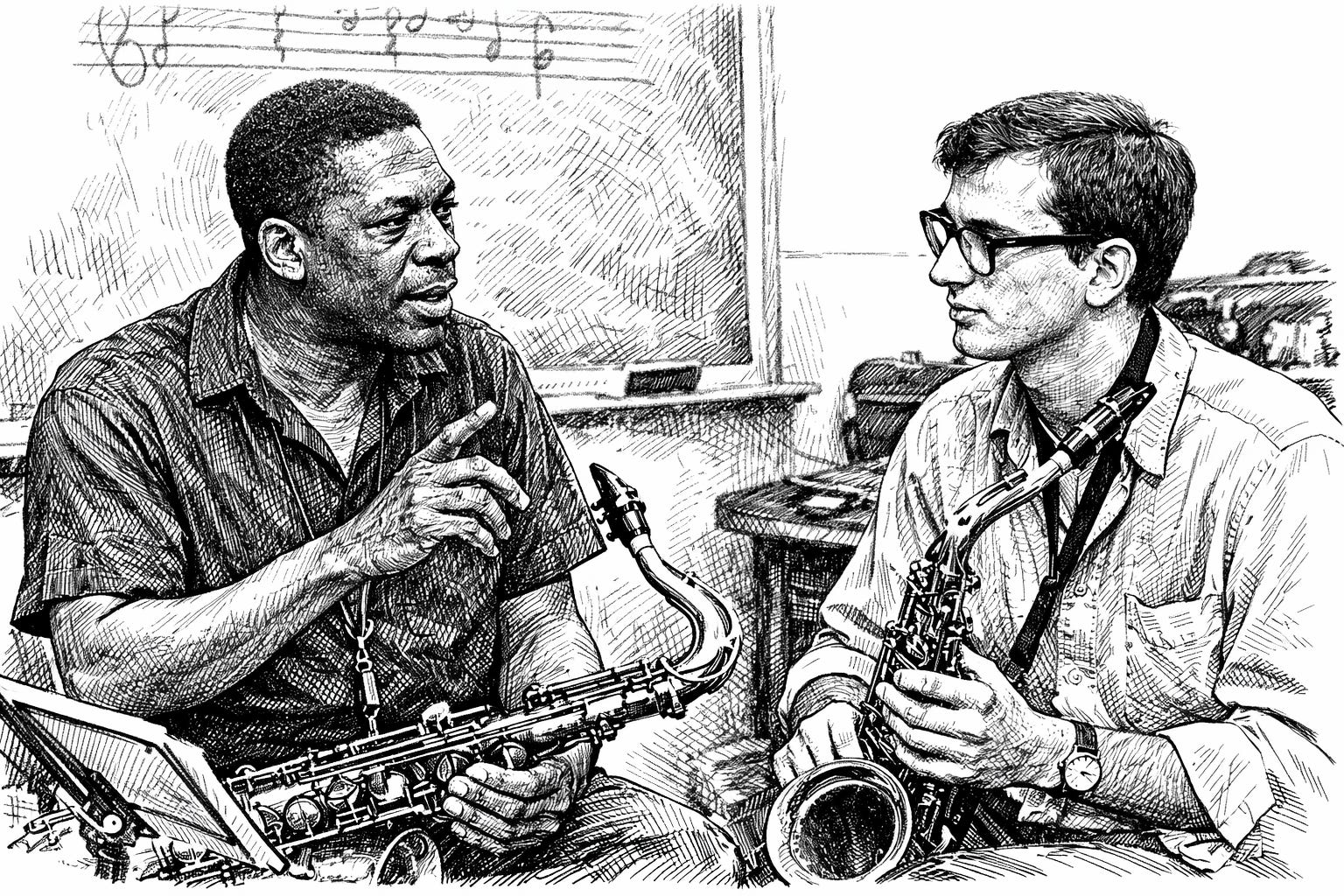
Michael Brecker, one of the most influential tenor saxophonists of the late 20th century, stood on the shoulders of a giant: John Coltrane. While Brecker developed his own distinctive voice that defined contemporary jazz and fusion, Coltrane’s profound influence shaped his artistic foundation in ways that resonated throughout his remarkable career.
Coltrane’s relentless pursuit of technical excellence and harmonic innovation provided a blueprint for Brecker’s own development. Coltrane’s “sheets of sound” technique, where rapid arpeggios created dense harmonic textures, directly influenced Brecker’s approach to improvisation. Brecker absorbed this concept and transformed it for the fusion era, applying Coltrane’s harmonic sophistication to funk grooves and electric contexts.
The harmonic language Coltrane developed, particularly through his work with modal jazz and the exploration of complex chord substitutions, became part of Brecker’s vocabulary. While Coltrane explored these concepts in acoustic settings, Brecker translated them into the high-energy world of fusion, proving that Coltrane’s innovations could transcend stylistic boundaries.
Coltrane’s spiritual quest, especially evident in works such as “A Love Supreme,” demonstrated that jazz could be a vehicle for profound personal expression and transcendence. This aspect of Coltrane’s artistry deeply influenced Brecker’s approach to music-making. Though Brecker worked more frequently in commercial and fusion contexts, his playing always maintained an emotional depth and seriousness of purpose that echoed Coltrane’s commitment to music as a spiritual practice.
Brecker understood that Coltrane’s legacy wasn’t just about notes and scales but about approaching the saxophone as a medium for conveying the full range of human experience. This understanding informed Brecker’s later work, particularly his final recordings made while battling the illness that would ultimately take his life, where the emotional intensity recalled Coltrane’s most powerful statements.
Coltrane’s powerful, vocalized tone set a standard for tenor saxophone sound that influenced generations. Brecker developed his own distinctive sound, one that incorporated elements of Coltrane’s fullness and intensity but adapted for modern contexts. Where Coltrane’s sound had a vocal, crying quality, Brecker’s had more edge and bite, perfect for cutting through electric instruments in fusion settings. Yet the foundation, that idea of a big, commanding sound that could fill a room and convey intense emotion, came directly from Coltrane’s example.
Coltrane’s compositional approach, particularly his use of modal frameworks and cyclic patterns, influenced how Brecker thought about structure in improvisation. Coltrane showed that jazz composition could move beyond traditional song forms into more open, exploratory territories. Brecker applied these lessons in his own compositions and in his approach to standards, often breaking down harmonic structures and rebuilding them in ways that showed Coltrane’s influence while remaining distinctly his own.
When Michael and Randy Brecker formed The Brecker Brothers, they created a fusion sound that, while far removed from Coltrane’s acoustic jazz, carried forward his spirit of innovation and technical excellence. The group’s high-energy funk-jazz demonstrated how Coltrane’s principles of harmonic sophistication and technical mastery could be applied to popular forms without sacrificing artistic integrity.
As Brecker matured as an artist, his connection to Coltrane became more explicit. His later acoustic work showed a more direct engagement with Coltrane’s legacy, particularly in his use of modal frameworks and his exploration of saxophone multiphonics and extended techniques. Albums in the 1990s and 2000s revealed Brecker coming full circle, acknowledging his debt to Coltrane while establishing his own place in the jazz continuum.
Perhaps one of the most significant ways Coltrane influenced Brecker was through his legendary work ethic. Coltrane’s devotion to practice, his constant search for new sounds and techniques, and his willingness to risk failure in pursuit of artistic growth set an example that Brecker followed throughout his life. Both men understood that mastery required endless dedication and that the saxophone was an instrument of infinite possibilities if one was willing to put in the work.
Coltrane’s influence on Brecker extended to how each man influenced subsequent generations. Just as Coltrane provided a model for serious jazz artistry, Brecker, building on that foundation, showed how Coltrane’s innovations could be adapted to contemporary contexts. This created a lineage where Coltrane’s influence flowed through Brecker to countless saxophonists who came after.
One of Brecker’s unique contributions was demonstrating how Coltrane’s advanced harmonic concepts could work in electric, funk-influenced settings. While some purists might have seen fusion as a departure from jazz tradition, Brecker showed that Coltrane’s spirit of innovation and harmonic sophistication could thrive in any context. This bridge-building between Coltrane’s legacy and contemporary music proved crucial for jazz’s evolution.
Michael Brecker’s relationship to John Coltrane exemplifies how artistic influence works at its best. Brecker didn’t merely copy Coltrane but absorbed his principles, adapted them to new contexts, and created something distinctly his own while honoring the source. Coltrane showed what was possible on the tenor saxophone, both technically and expressively. Brecker took those lessons and proved their relevance for a new era, ensuring that Coltrane’s revolutionary approach continued to shape jazz long after his death.
The influence wasn’t about imitation but about inspiration. Coltrane opened doors that Brecker walked through into new territory, carrying forward the values of technical excellence, emotional depth, harmonic sophistication, and spiritual commitment that defined Coltrane’s artistry. In doing so, Brecker became not just an inheritor of Coltrane’s legacy but an essential link in the chain that continues to connect Coltrane’s innovations to contemporary jazz practice.
In the late 1990s, Saxophone Summit came together with a clear mission: honoring the later music of John Coltrane. The ensemble brought together three of the most accomplished tenor saxophonists of their generation: Michael Brecker, Joe Lovano, and David Liebman, who also played soprano saxophone. The rhythm section featured Phil Markowitz on piano, Rufus Reid on bass, and Billy Hart on drums.
On December 18, 1999, I produced what became the first live jazz video webcast from Birdland, a historic moment in jazz broadcasting. This clip from that groundbreaking performance captures Michael Brecker soloing on Miles Davis’s “All Blues.” The performance reveals the powerful influence Coltrane exerted on Brecker, Liebman and Lovano, and their fellow saxophonists, showing how deeply his approach to improvisation, sound, and musical exploration had become woven into their own artistic voices.
View the entire “All Blues” from that incredible night go here
If one is interested in exploring this further, Sher Music recently published a condensed and annotated book of Breckers practice notebooks.
Excellent piece and the video is sensational!