

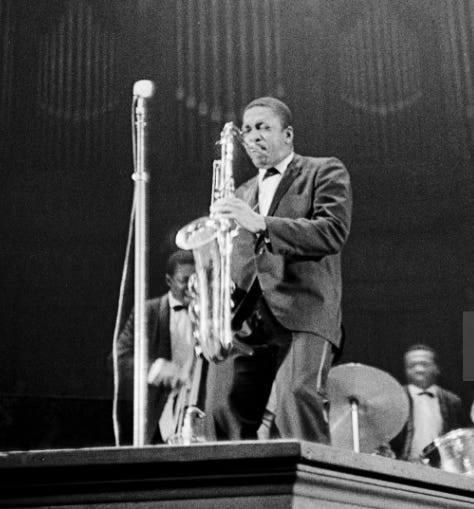
This was a remarkable moment captured on film and released decades later. The John Coltrane Quartet performed “Naima” at the Antibes Jazz Festival on July 27, 1965, with McCoy Tyner on piano, Jimmy Garrison on bass, and Elvin Jones on drums.
The festival organizers had requested that Coltrane perform more familiar material on the second night, July 27, after he had performed a 48-minute version of A Love Supreme the previous evening. The version of “Naima” from that July 27 performance became part of the album “Live in Antibes,” which was released years later in 1988.
Saxophonist David Liebman, who later played with Elvin Jones, described this particular “Naima” as having Coltrane “solos combining a striking lyrical approach offset by multi-noted, densely packed runs.” He noted that even familiar tunes such as “Naima” were much more intense than any recordings the public might have been familiar with at the time.
This European tour in July and August 1965 marked Coltrane’s last appearance in Europe. The performance was filmed by French television, giving us a rare visual document of the Classic Quartet near the end of its time together.
“Naima” is one of John Coltrane’s most beloved compositions, a ballad that stands apart from his more intense and exploratory work. Here’s what makes it significant:
Coltrane wrote “Naima” in 1959 and named it after his first wife, Juanita Naima Grubbs. The piece reflects a tender, introspective side of his artistry.
The composition is a slow, meditative ballad built on a modal structure rather than traditional chord progressions. It features a distinctive bass pedal point that anchors the harmonic movement, creating a floating, dreamlike quality. The melody unfolds gradually with a singing quality that showcases Coltrane’s lyrical approach to the soprano and tenor saxophone.
The original studio version appeared on the landmark 1960 album “Giant Steps.” That recording features Coltrane on soprano saxophone, with McCoy Tyner on piano, Steve Davis on bass, and Lex Humphries on drums. The piece became a jazz standard, performed and recorded by countless musicians across generations.
As Coltrane’s style evolved through the 1960s, so did his interpretations of “Naima.” While the studio version is serene and contemplative, later live performances grew increasingly intense and searching, reflecting his ongoing spiritual and musical journey. The 1965 Antibes performance we discussed earlier exemplifies this transformation.
The composition remains one of the most recorded and studied pieces in the jazz canon, admired for its beauty, emotional depth, and sophisticated harmonic structure.
Isn't his tone beautiful on this recording?
It is my opinion, but I feel that John wrote lyrics to his Naima composition.