

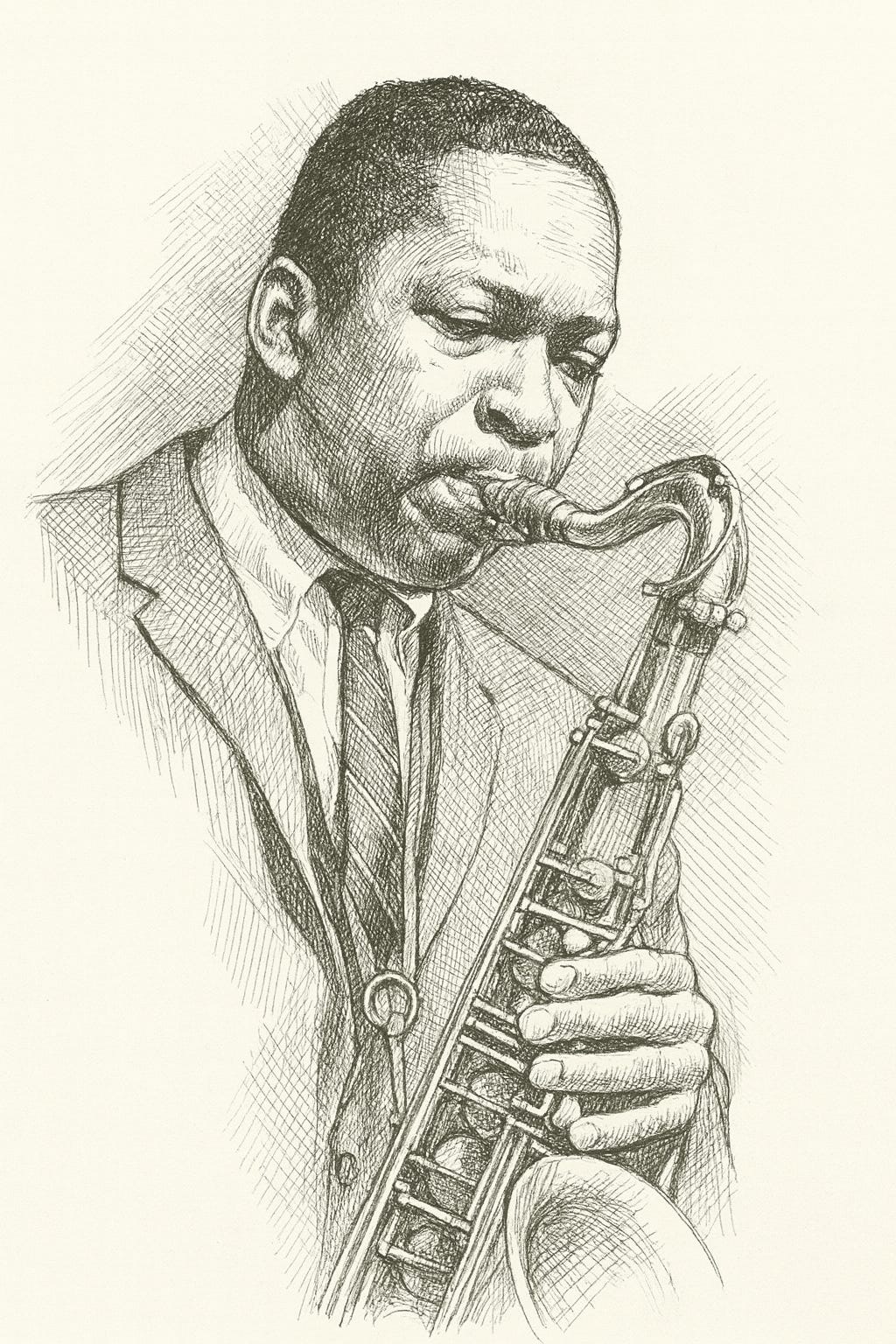
Frank Kofsky's 1966 interview with John Coltrane stands as one of the most revealing and politically charged conversations ever recorded with the jazz giant. Conducted during the height of the Civil Rights Movement and at a crucial juncture in Coltrane's artistic evolution, this interview captures a musician grappling with questions of race, politics, and artistic responsibility that would define his final years.
The Context of 1966
By 1966, John Coltrane had already revolutionized jazz multiple times. From his hard bop beginnings through his modal explorations with Miles Davis, his own classic quartet period, and into his increasingly avant-garde investigations, Coltrane had established himself as perhaps the most important voice in contemporary jazz. Yet this period also marked a time of intense social upheaval in America, and Coltrane found himself increasingly drawn to questions beyond pure musical innovation.
Frank Kofsky, a jazz critic and political activist, approached Coltrane with a specific agenda. Kofsky sought to explore the connections between jazz and Black political consciousness, believing that the music served as a form of cultural resistance. His questions pushed Coltrane to articulate his own understanding of these relationships, often in ways that seemed to surprise even the saxophonist himself.
Political Awakening Through Music
One of the most striking aspects of the interview is Coltrane's evolving political consciousness. When Kofsky pressed him about the political implications of his music, particularly pieces such as "Alabama" (his response to the 1963 church bombing in Birmingham), Coltrane initially seemed reluctant to embrace an explicitly political role. He spoke of music as a spiritual force, something that could heal and uplift, but hesitated to claim it as a weapon of political struggle.
However, as the conversation progressed, Coltrane began to acknowledge the inherent political dimensions of his work. He discussed how the conditions of Black life in America inevitably shaped his music, even when he wasn't consciously addressing political themes. The interview reveals a man coming to terms with the fact that his art could not be separated from the social realities surrounding it.
The Question of Audience
Kofsky challenged Coltrane on questions of audience and accessibility. The critic suggested that Coltrane's increasingly complex and experimental music might be alienating the very Black audiences who could most benefit from its message of resistance and empowerment. This tension between artistic integrity and social responsibility clearly troubled Coltrane, who admitted to feeling torn between his need for musical exploration and his desire to reach people.
Coltrane's response revealed his deep sincerity about music's spiritual function. He spoke of music as a force for healing and consciousness-raising, but acknowledged the paradox that his most adventurous work might be reaching primarily white, intellectual audiences rather than the Black communities from which it emerged. This conversation illuminated one of the central dilemmas facing Black artists during this period: how to maintain artistic freedom while serving their communities' political and cultural needs.
Spiritual and Political Synthesis
Perhaps the most fascinating aspect of the interview is how it captures Coltrane attempting to synthesize his spiritual and political concerns. Throughout his career, Coltrane had spoken of music in deeply spiritual terms, referencing his religious awakening in the late 1950s and his ongoing search for transcendence through sound. Kofsky's questions forced him to consider how this spiritual quest related to the political struggles of his time.
Coltrane began to articulate a vision of music as both personal spiritual practice and collective political action. He spoke of his responsibility as an artist to address the suffering around him, while maintaining that his primary obligation was to the music itself. This tension would characterize his final recordings, which often seemed to exist simultaneously as avant-garde sound explorations and expressions of social anguish.
The Interview's Legacy
The Kofsky interview became a crucial document for understanding Coltrane's final period, when his music grew increasingly intense and experimental. Albums such as "Ascension" and "Interstellar Space" can be heard differently when viewed through the lens of this conversation, their apparent abstraction revealing itself as responses to concrete social realities.
The interview also influenced how later critics and musicians understood the relationship between jazz and politics. Kofsky's approach, while sometimes heavy-handed, opened up important questions about the social function of art and the responsibilities of artists during times of social upheaval. His insistence on viewing jazz as political expression, rather than mere entertainment or aesthetic exercise, helped establish frameworks that continue to influence jazz criticism today.
Coltrane's Reluctant Radicalism
What emerges from the interview is a portrait of Coltrane as a reluctant radical, someone whose artistic development inevitably led him toward political consciousness despite his initial desire to remain focused on purely musical matters. His responses reveal a thoughtful artist grappling with the implications of his position as a prominent Black musician during a time of social transformation.
Coltrane's ultimate synthesis, achieved in his final recordings, suggested that the spiritual and political could not be separated. His music became a form of prayer that was simultaneously a cry of protest, a search for transcendence that acknowledged the harsh realities of earthly existence. The Kofsky interview captures him in the process of working through these ideas, making it an invaluable document of artistic and political development.
Conclusion
Frank Kofsky's 1966 interview with John Coltrane remains essential reading for anyone seeking to understand the intersection of art and politics in American culture. While Kofsky's aggressive questioning style sometimes seemed to push Coltrane beyond his comfort zone, it also elicited responses that revealed the depth of the musician's thinking about his role as an artist and citizen.
The conversation ultimately demonstrates how external pressures can help artists clarify their own positions and purposes. Through Kofsky's prodding, Coltrane was forced to articulate ideas about music, politics, and social responsibility that would shape his final creative period. The interview stands as testimony to the power of engaged criticism and the importance of challenging artists to consider the broader implications of their work.
In the end, the Kofsky-Coltrane interview serves as both historical document and ongoing inspiration, reminding us that great art emerges not from isolation but from deep engagement with the pressing questions of its time.
It's been a while since I read this interview, but my emotional response to it remains strong. Kofsky's bullheaded and bullying attempt to forward his own agenda really pissed me off. Kofsky kept trying to shove Coltrane into his own tiny political boxes and Trane was simply too much of a gentleman to lash out at him or walk away. He found a way to try and ameliorate the conversation. I respect the spin you're trying to put on this Bret, but Coltrane's vision was always broadly humanitarian and Kofsky's was fundamentally authoritarian and ego-driven.
Bret, thank you for bringing this historically important interview to your audience, Substackers and beyond. I think you identified what made this interview between Kofsky and Coltrane so unique: "The conversation ultimately demonstrates how external pressures can help artists clarify their own positions and purposes." I spent significant time with Frank during his History Prof tenure at California State University at Sacramento when he was writing a Bay Area music column for The Sacramento Bee. He took an interest in me as a pianist and composer. Since I was also his student and assigned Black Nationalism and the Revolution in Music as our textbook, I attended and transcribed interviews for him as well. Most significantly, time spent with Andrew Hill, Dexter Gordon, Bobby Hutcherson, Max Roach, Eddie Henderson and many others—Andrew in his home when he lived in SF, the others backstage at Keystone Korner. I was only 19-20 at the time, so you can imagine the altitude of the cloud I was riding on. Back to the point: Frank most definitely held admiration for Black Nationalism as filtered through his own Marxism and opinions about what he considered to be authentic Black American improvisational music. He did not hold back in the prodding/steering department as you point out. I will say that Andrew Hill warned Frank not to call him a jazz musician or he'd punch him in the face. Frank may have met his match in Mr. Hill. Thank you for stirring ancient memories that still have deep meaning for me. Peace.