

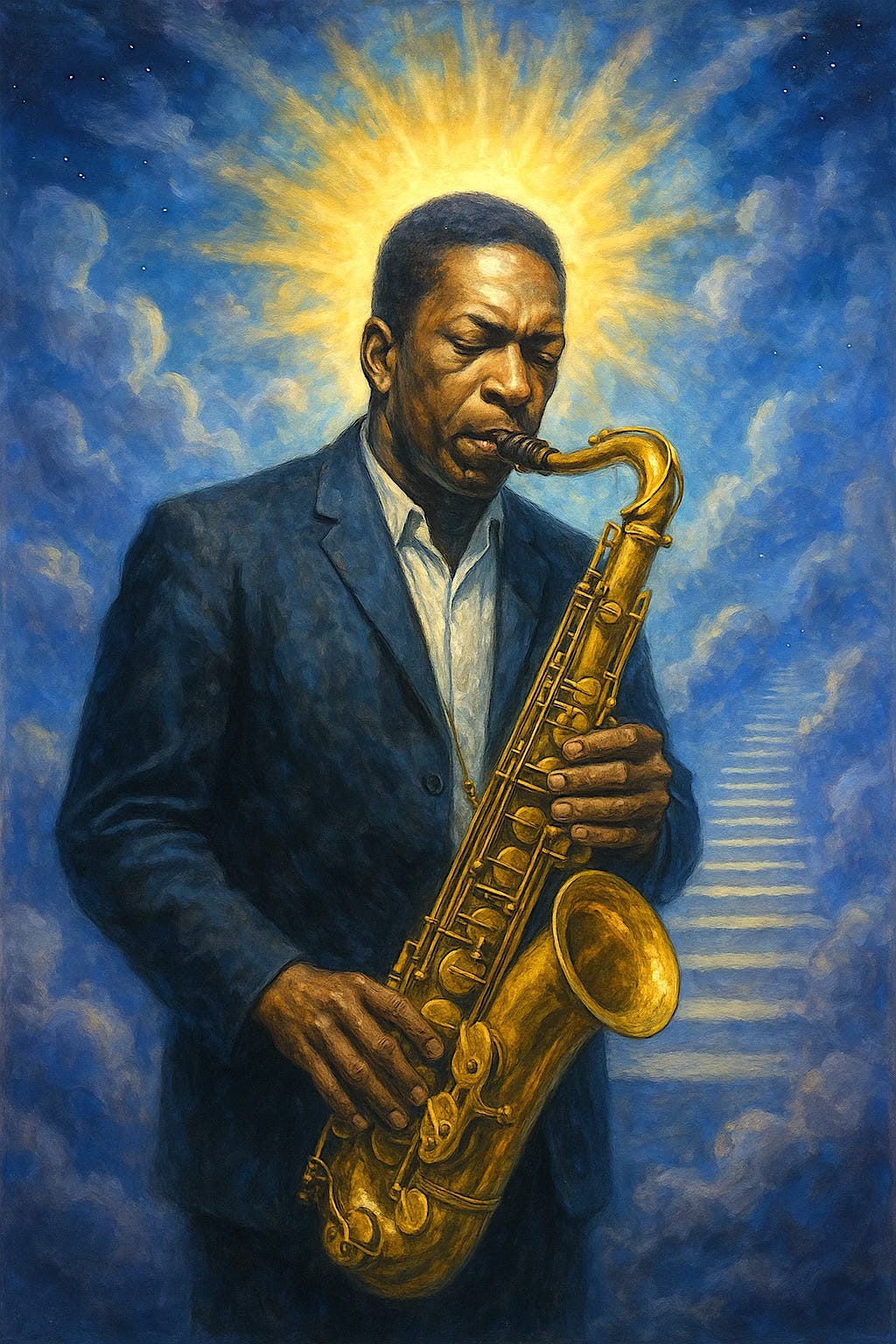
Fiction - A story about Coltrane in the Bardo
Coltrane opens his eyes after death in a strange, boundless space where his saxophone won’t make a sound and a mysterious guide calling himself “Monk” explains he’s entered the Bardo, the realm between lives. To move forward, Coltrane must face the truth of his life without hiding behind music. He’s pulled through shifting visions that force him to confront addiction, ego, brilliance, love, and the weight of his own legend. As he moves deeper, the boundaries of identity, faith, sound, and self begin to dissolve, and he discovers that the divinity he chased through decades of music was never in the horn. It was inside him. At the end of his journey, Coltrane is presented with a choice that will define what comes next.
- - - - - - -
John Coltrane opened his eyes to a darkness that hummed.
Not the darkness of a closed room or a moonless night, but something older. The kind of dark that existed before the first note was ever played. His bare feet touched a floor that felt both solid and weightless, glossy black, reflecting a light he couldn’t locate. The air tasted of copper and rain.
He looked down at his hands. Empty. Wrong. His fingers twitched, searching for valves that weren’t there.
“No train tracks,” he said, and his voice fell into the void without echo. “No skyline. No band.” He touched his chest. No pain. No breath, exactly, but something moving through him. “Not even my horn.”
Then he saw it: twenty feet away, glowing faintly on a pedestal. His saxophone. Except it wasn’t his saxophone. It looked carved from light, surrounded by fog that moved against wind that wasn’t there.
He approached slowly, the way you approach a sleeping animal. When he touched it, the metal wasn’t cold or warm. It vibrated under his palm, a frequency he felt in his teeth. He lifted it and pressed his lips to the mouthpiece.
Nothing. Not even breath. Not even the mechanical click of keys.
He lowered the horn and laughed once, sharp and bitter. “So this is it. This is the punch line.”
“Is it?”
The voice came from everywhere. Coltrane spun. A man stood where no man had been, barefoot, wrapped in grey robes that moved without wind. His face was ageless. Could’ve been thirty. Could’ve been three hundred.
“Who are you?” Coltrane asked.
“Does it matter?”
“You Saint Peter? Mingus? My grandfather?”
“I’m whoever you need me to be. Today, let’s say I’m the silence between your notes.” The man smiled. “You can call me Monk if it helps you listen.”
Coltrane’s laugh caught in his throat. “Monk’s a piano player.”
“Monk’s a state of mind.”
They studied each other. The Monk moved closer, footsteps soundless. Up close, Coltrane could see through him slightly, the way you can see through cigarette smoke if you squint.
“So I died,” Coltrane said. Not a question.
“Yes.”
“When?”
“Does it matter?”
“I’d think I’d remember my own death.”
“You remember pain,” the Monk said. “The body remembers its exit. But you’re not the body anymore. You’re what played through it.”
Coltrane set the glowing saxophone down. He sat on the floor, cross-legged, the way he used to sit in hotel rooms at 4 AM when the heroin was gone and the horn couldn’t save him and he’d just sit there, shaking, waiting for the sun to tell him he’d survived another night.
“I thought there’d be more,” he said quietly. “Fire or judgment. Naima waiting. My mother. Something.”
“You brought your own light,” the Monk said, sitting across from him. “But you’re not done yet.”
“How can I be not done? I’m dead.”
“The body’s finished. The sound isn’t.” The Monk leaned forward. “Tell me something. What were you playing for?”
“What?”
“All those years. All those notes. The sheets so black with eighth notes they looked like fly paper. What were you chasing?”
Coltrane’s jaw tightened. “God.”
“Did you find him?”
“Sometimes. In the horn. Between the changes. When the rhythm section locked in and Elvin was pushing time and Alice was floating those chords and I’d close my eyes and just blow and blow until there was nothing left of me, just sound, just vibration, just—” He stopped. His hands were shaking. “Yeah. Sometimes I found him.”
“And the other times?”
Coltrane looked away. “The other times I found myself. Which was worse.”
The Monk nodded slowly. “You’re in the Bardo now.”
“The what?”
“The space between lives. The Tibetans have a whole book about it. I think you read it once, backstage somewhere, between sets, nodding off.”
Coltrane closed his eyes. He did remember. A thin paperback someone gave him in San Francisco. He’d read it like a man reads a menu in a language he doesn’t speak. “I don’t believe in reincarnation.”
“Your belief isn’t required.”
“Then what is?”
“Your attention.” The Monk stood. The space around them began to shift, the black floor rippling. “Six movements. Six realms. You’ll see everything you were. Everything you thought you were. And then you’ll choose.”
“Choose what?”
“Whether to dissolve into the light or do it all again.” The Monk began to fade backward into shadow. “First movement: memory. Be ready to see yourself without the horn. That’s when it gets interesting.”
“Wait—”
But the Monk was gone. And Coltrane was alone with the glowing saxophone, which had started to play itself now, a single repeating phrase from “Acknowledgement,” over and over, growing louder until it wasn’t music anymore but a heartbeat monitor, beeping, steady, then erratic, then—
---
The floor became a hospital bed beneath him.
Coltrane lay on his back, chest heavy, an IV snaking into his arm. But the tube didn’t connect to anything. It just hung in midair, dripping light instead of morphine. The walls were white but translucent, and behind them, shadows moved. Doctors. Nurses. Alice. All of them distorted, stretched, moving in slow motion.
He tried to sit up. Couldn’t. The weight on his chest wasn’t physical. It was the weight of every note he’d ever played, pressing down.
“This is where the body gave its final rhythm,” the Monk said. He stood at the foot of the bed now, dressed in a white coat, stethoscope around his neck. “Can you feel it?”
“I’m not dying again,” Coltrane said. “I already died.”
“This isn’t your death. This is your memory of dying. The self remembers its ending. The soul just watches.”
A door opened that Coltrane hadn’t noticed. Through it walked another version of himself: young, maybe twenty-five, sharp-suited, hair processed, tenor saxophone slung over his shoulder. The young man walked past the bed without seeing it, lifted the horn, and began to play. Fast, angry, beautiful. A solo from “Moment’s Notice” or maybe “Countdown.” So fast the notes blurred together, running from something.
“That’s you in 1951,” the Monk said. “Still trying to outplay the pain.”
“I was good,” Coltrane whispered.
“You were desperate.”
The young man vanished mid-phrase. The door opened again. This time, a skeletal figure stumbled through: Coltrane at his worst, maybe 1957, eyes sunken, skin grey, hands shaking so badly he could barely hold the horn. He tried to play and produced only spit and squeaks. He swore and slammed the saxophone against the wall. It made no sound.
“I buried him,” Coltrane said, looking away. “Alice helped me. I quit. I got clean. I found God.”
“You didn’t bury him. You built a cathedral on top of him.” The Monk moved closer. “Every note you played after that was trying to prove you’d transcended. But you can’t transcend what you won’t face.”
“I faced it. Every damn day.”
“Did you? Or did you just play louder?”
The skeletal Coltrane looked up suddenly, directly at the bed, directly at him. When he spoke, his voice was Coltrane’s voice, younger, rawer, true.
“I need the fix,” the shadow said. “I need the line. I need the sound to be faster than the pain. I need Miles to call me back. I need the lights. I need the applause. I need Alice to forgive me. I need to sleep. I need to blow until my lungs collapse. I need God to tell me I’m chosen. I need proof I’m not wasting my life. I need—”
“Stop,” Coltrane said.
“I need to be more than a junkie from North Carolina who got lucky.”
“I said stop.”
“I need to matter.”
Coltrane tried to get out of the bed. The weight on his chest doubled. “I mattered. I changed music. I found something real.”
“Did you?” The shadow stepped closer. “Or did you just convince everyone you had?”
The Monk touched the shadow’s shoulder. The figure froze, then slowly faded. The weight lifted. Coltrane could breathe again.
“That’s the first layer,” the Monk said quietly. “The story you told yourself about yourself. It has to burn away.”
Behind him, on a monitor above the bed, Alice appeared. Not in the room but on the screen, seated at a Wurlitzer, playing something slow and angular. She looked at the camera, looked at Coltrane.
“You were always searching,” her voice came through, distorted slightly. “Even in bed. Even in pain. You weren’t dying. You were tuning. Trying to find the one frequency that would finally make you whole.”
“Alice—”
“But you were already whole, John. You just couldn’t hear it through the horn.”
The monitor went dark. The bed began to sink into the floor. Coltrane scrambled to stand, and suddenly he was standing, in the void again, the hospital dissolved.
“What now?” he said to the Monk.
“Now you meet the light you were chasing.”
---
The floor turned white.
Not the white of hospital walls or fresh paint, but the white of something burning so bright you see it through closed eyelids. The space opened vertically, a sense of infinite height, no ceiling, just up and up and up into something that made his eyes water.
Coltrane stood in the center of it, barefoot, his tunic now glowing faintly. He held up his hand and watched light pass through his palm. He could see his bones. He could see past his bones.
“This is too much,” he said. But his voice sounded different. Younger. Unguarded.
“This is what was always there,” a voice said. “You just couldn’t hear it through the static.”
Alice emerged from the light itself, dressed in gold, barefoot, moving without walking. She radiated something that wasn’t heat but felt warm. When she looked at him, he felt transparent. Seen.
“Is this heaven?” he asked, and his voice cracked on the word.
“No.” She smiled. “It’s what was always inside you. The space behind the sound.”
He took a step toward her. She didn’t move but somehow she was closer. “I don’t understand.”
“You thought divinity lived in scales,” she said. “In modes. In sheets so black with notes you couldn’t see the paper underneath. You thought if you played long enough, hard enough, pure enough, you’d finally arrive. But this—” She touched his chest, and he felt the touch everywhere. “This was already here. Before you picked up the horn. Before you took your first breath. Before John William Coltrane was born in Hamlet, North Carolina, in 1926.”
He looked down at his hands again. They were fading, becoming translucent. “I’m disappearing.”
“You’re becoming what you always were.”
“Which is what?”
“Awareness. Vibration. The listener and the listened-to. No separation.”
He sank to his knees. Not in despair but in something larger. The feeling he’d chased for forty years, the one he’d only touched maybe a dozen times, usually at the end of a three-hour set when his lips were bleeding and his fingers cramping and the audience had thinned to the faithful and he’d finally, finally stopped trying and just played. That feeling. Except now it wasn’t a feeling. It was everything.
“I thought I was the sound,” he whispered. “The solo. The burning soul at the mic. The sheets of sound. The spiritual. The seeker. I thought that was me.”
“That was the costume you wore. The role you played.” Alice knelt in front of him. “You were always the silence underneath. The space that shaped the sound. The rest between the notes.”
He started to weep. Not in sadness but in relief so profound it felt physical. All those years. All those notes. All that searching. And here it was. Here it had always been. The joke was on him.
“What happens if I let go?” he asked. “If I just dissolve into this? Do I become God?”
“No. You return to what never left. A single vibration in a field of infinite tone.”
“No more me.”
“No more you.”
He thought about that. No more John Coltrane. No more legacy. No more people arguing about whether his late work was genius or self-indulgence. No more students trying to transcribe his solos. No more anything. Just this light, this peace, this endless humming silence.
“I could stay here,” he said.
“You could.”
“It’s what I wanted. My whole life. To finally merge with it. To stop being separate. To stop—” He stopped. Something pulled at him. A sound, faint and far below. A question he hadn’t answered. “But there’s still something calling me.”
“I know.”
“A note I didn’t resolve. Something I missed while I was trying so hard to transcend.” He looked at her. “If I stay here, I’ll never know what it was.”
She smiled sadly. “Then you have your answer.”
“If I go back, will I remember you?”
“Not with your mind. But your fingers will remember. Your lungs. Your ears. And when you find the horn again—not as glory, not as proof, but as grace—you’ll know. You’ll feel this moment. You won’t remember it, but you’ll feel it.”
He reached for her face. His hand passed through her. They were both made of light now.
“Thank you,” he said. “For every step I couldn’t take. For every time you waited while I chased this thing I already had.”
“You had to chase it,” she said. “That was your path. Your specific madness. And it was beautiful, John. Even when it hurt.” She began to fade. “Now go find the other way.”
“What other way?”
“The way that doesn’t require suffering to find God.”
She vanished. The light dimmed. Coltrane stood alone in the white space, which was already beginning to crack, shadows seeping in through the cracks, and with the shadows came sound: voices, laughter, accusations, music distorted beyond recognition.
---
The space shattered into pieces.
Coltrane stumbled as the floor broke beneath him, reassembled, broke again. Mirrors spun. Projections flickered across every surface: smoky clubs, recording studios, his face on magazine covers, his face gaunt with sickness, his face lost in a solo, eyes closed, gone.
Sound crashed over him: arguments with Alice, critics calling his music “anti-jazz,” Miles saying “man, you play too much,” Elvin’s drums speeding up impossibly fast, his own voice in interviews saying “I’m trying to get closer to God” over and over until the words lost meaning.
“Welcome to the remix!”
A figure appeared at a DJ booth that materialized from nowhere: flamboyant, draped in sequins and robes, wearing headphones that glowed. The figure grinned, spinning records that looked like galaxies.
“This is the Projection Chamber, baby,” the DJ announced. “Where every truth gets spun twice and every lie has a trumpet section. Let’s hear what the universe archived about John William Coltrane, shall we?”
The DJ scratched a record. The sound was Coltrane’s own solo from “Chasin’ the Trane,” but wrong, distorted, eating itself.
Figures emerged from the chaos: Miles Davis, cool and cutting. “You were preaching, not playing. Every solo was a sermon with no amen. You forgot that jazz is supposed to swing, man. You forgot about the people who have to listen.”
A critic with a pen: “Coltrane’s music is chaos! Self-indulgent. Where’s the melody? Where’s the structure? He’s disappeared up his own asshole.”
A young musician, angry: “You set us free and then abandoned us. You opened the door to freedom and then you died. What are we supposed to do now?”
Alice appeared, but not the luminous Alice from the light. This was Alice exhausted, Alice hurt, Alice holding their son Ravi while Coltrane practiced for eight hours straight in the next room. “You were there but never present. You played for God but forgot our son’s name some mornings.”
“I remember his name,” Coltrane said. “I remember all their names. Naima. John Jr. Ravi. I named a song for Naima.”
“You named a song,” the Alice-figure said. “But did you stay for breakfast?”
The skeletal shadow version of himself burst through the crowd, saxophone hanging from his neck, eyes wild. “You think you transcended me? I’m still here. I’m your engine. I’m what made you practice till your lips bled. I’m what made you matter. Every prayer you played was powered by shame. You didn’t find God. You just found a better drug.”
“No,” Coltrane said. But his voice was weak.
“Yes. You traded heroin for holiness. Still chasing. Still running. Still trying to prove you weren’t just a junkie from Hamlet who got lucky in Philly.”
“I beat you. I got clean.”
“You whitewashed me. Built a shrine on top of my grave. Called it ‘A Love Supreme’ and convinced everyone you’d transcended. But you didn’t transcend shit. You just played louder.”
The shadow rushed him. Coltrane flinched, but the figure passed through him, leaving cold in its wake. The cold spread through his chest. The truth of it.
He had been running. From himself. From his father’s death. From his mother’s sadness. From being Black in America in 1926, 1940, 1955, 1967. From the knowledge that no matter how many notes he played, he was still mortal, still fallible, still the kid who got hooked because the pain was too big and heroin made it smaller.
The ensemble of figures circled him, voices overlapping: “Too long.” “Too loud.” “Too late.” “Not enough.” “Too much.” “Lost.” “Prophet.” “Fraud.” “Genius.” “Addict.” “Saint.”
Coltrane fell to his knees, hands over his ears. “I don’t know who I am without the horn!”
The voices stopped.
The DJ cut the music. Silence fell, sudden and complete.
“There it is,” the DJ said softly, stepping down from the booth. Up close, Coltrane realized the DJ was another version of himself: the self he might have been if he’d never picked up a horn. Happy. Unburdened. Free.
“That’s the truth that was hiding under all those notes,” the DJ said. “You didn’t know who you were without the search. The identity. The legend. The suffering. You couldn’t just be John. You had to be John Coltrane.”
The DJ held out a small mirror. “Look.”
Coltrane looked. There was no reflection. Just a faint glow where his face should be.
“You’re not the notes,” the DJ said. “Never were. You were the space between them. The silence that gave them shape. The listening that made them possible.” He put the mirror away. “Now you know. Now you can let go.”
The figures began to fade. Miles, the critics, the shadow self, even Alice. They dissolved into smoke. The mirrors stopped spinning. The projections went dark.
Coltrane stood. His chest felt lighter. The DJ smiled and vanished with a wink.
The Monk appeared again, simple grey robes, bare feet. “Ready for the last movement?”
Coltrane nodded. “Yeah. I think I am.”
---
The space opened into a horizon.
Golden-orange light washed everything, soft as sunrise. In the distance, a circle of light pulsed slowly, rhythmically. A portal. A threshold. The way forward or the way back, Coltrane couldn’t tell.
The Monk walked beside him. They walked in silence for a long time, footsteps soundless on the glowing floor.
“You’ve seen your life now,” the Monk finally said. “The notes and the noise. The beauty and the bullshit. The parts you got right and the parts you missed while trying so hard to be righteous.”
“Yeah.”
“So. The question.” The Monk stopped walking. Coltrane stopped too. They stood together, facing the circle of light. “Will you stay in the formless light and dissolve? Or will you return?”
“What would I return as?”
“Anything. Anyone. A breeze. A musician. A child. A silence in someone’s prayer. But if you choose rebirth, you forget everything. Even her. Even the horn. Even this conversation.”
Coltrane looked at the light. It was beautiful. Peaceful. Everything he’d been searching for. No more pain. No more doubt. No more waking up at 4 AM wondering if he was wasting his life.
But something pulled at him. That unresolved note. That question.
“There’s a part of me,” he said slowly, “still reaching. Still aching to express something I never could. Because I was too busy trying to play God. Now...” He turned to the Monk. “Now I want to listen to God. I want to come back with empty hands. With ears wide open. No reputation. No expectations. No John Coltrane.” He smiled. “Just breath. Just curiosity. Just someone who might pick up a horn one day and play it without needing it to save him.”
The Monk bowed his head. “Then you will return. Not as Coltrane. But as vibration made flesh again. The music will find you. Not to glorify you. To serve something larger.”
“Will it hurt?”
“Being born? Yes. Growing up? Yes. Living? Yes. But you won’t remember this conversation. You won’t remember that it gets better. That’s the deal.”
Coltrane thought about that. Then he bowed, fully, head to the floor, the way he’d seen monks bow in books. A gesture of surrender. Of gratitude. Of goodbye to everything he’d been.
The Monk knelt beside him and placed a small bell on the floor. He rang it once. The tone was pure, singular, perfect. It resonated through everything. And as it faded, new sounds emerged: a heartbeat. Water. Wind. A baby’s first breath.
“Send me back,” Coltrane whispered. “Where no one knows my name.”
The light overtook everything.
---
In the darkness, a child cried.
Not a wail but a small sound, confused, new. The sound of something that didn’t exist a moment ago suddenly existing. The shock of it.
A woman’s voice, exhausted, tender: “It’s a boy.”
Another voice: “He’s got strong lungs.”
Laughter, soft. The rustle of blankets. The warmth of skin against skin. The baby’s cry settled into steady breathing. In. Out. In. Out.
Far away, in another lifetime, John Coltrane had played his last note.
Here, now, someone new was learning to breathe.
The Monk’s voice, impossibly distant: “Go softly now. Back to the world. Back to forgetting. Back to skin and hunger and wonder. The sound will return. And one day you’ll pick up a horn again. Not to transcend life. To sing it.”
The baby’s tiny hand opened and closed, reaching for something it couldn’t name yet. Something about frequency. About vibration. About the way silence shapes sound.
A nurse hummed tunelessly as she cleaned the baby’s eyes. The hum had no melody. But somewhere in it, barely audible, was the opening phrase of “Acknowledgement.”
The baby didn’t recognize it. Not yet.
But his fingers twitched in time.
Outside the window, the sun rose over whatever city this was, whatever year, whatever life.
And somewhere in the distance, a saxophone waited.
Thank you for this! Having lost my partner of 43yrs just last April, I have to say that this really moved me … An artist herself, my partner was an amazing creative fireball, always a bit larger than life – & yes! Very driven … As I was reading, my imagination couldn't help but extend to a vision of her own passage thru the bardo, similar to John's … I found real comfort in that, even as the story reminded me of how much I need to be able to let my loved one go as she embarks into the What's Next …
I love your work and I'd love to collaborate. I did some real academic research in college on Coltrane and would love to share it and chat about it