

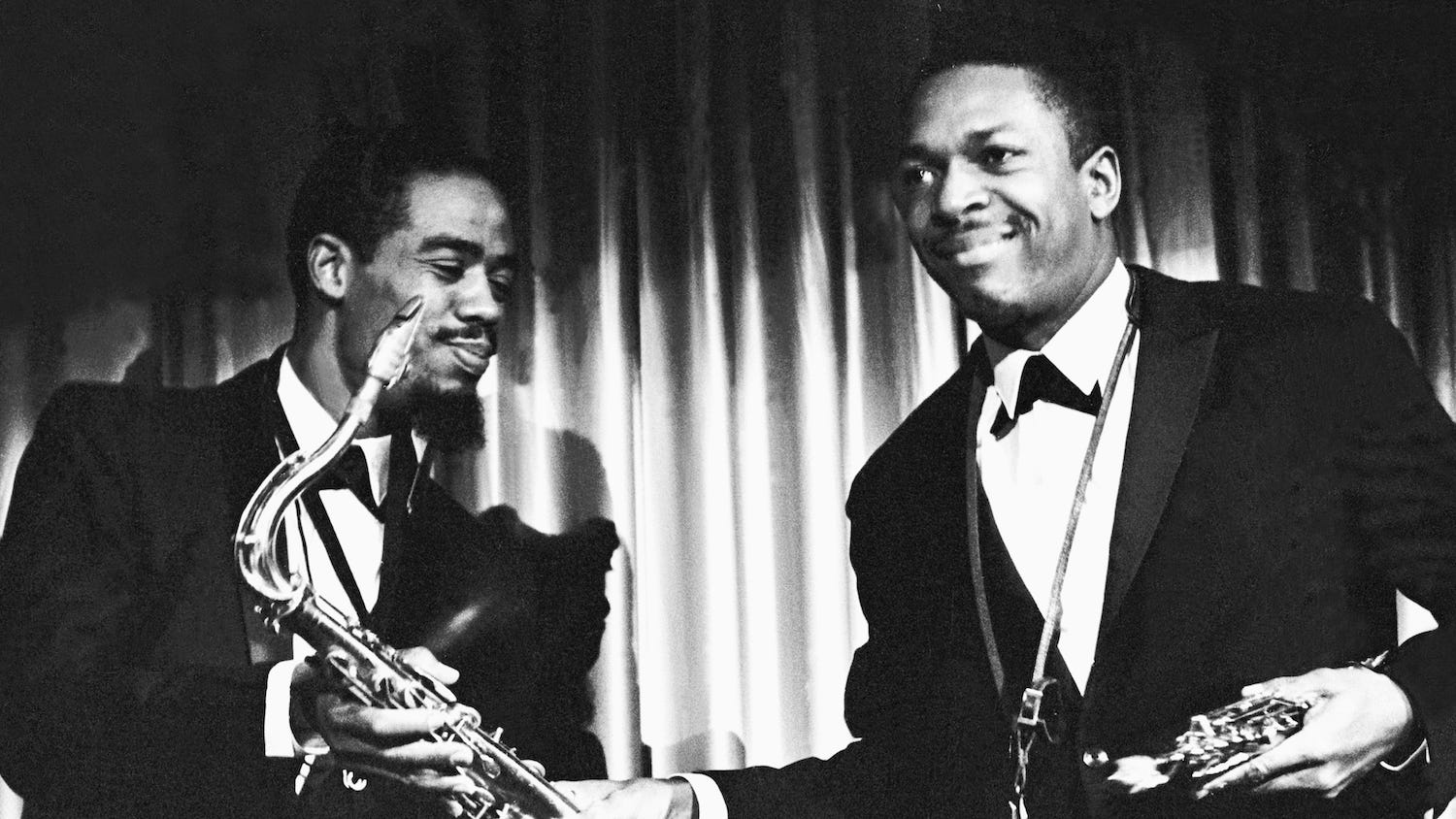
The friendship between John Coltrane and Eric Dolphy was rooted in something deeper than musical kinship. They had known each other long before they formally played together, having met when Coltrane was in Los Angeles with Johnny Hodges in 1954. For seven years they talked music, exchanged ideas, and watched each other grow. Coltrane described it plainly: “Eric and I have been talking music for quite a few years, since about 1954. We’ve been close for quite a while. We watched music. We always talked about it, discussed what was being done down through the years, because we love music.”
When Dolphy finally joined Coltrane’s band formally in early 1961, the effect was immediate and seismic. Coltrane recalled the moment: “He came in, and it was like having another member of the family. He’d found another way to express the same thing we had found one way to do.” Coltrane acknowledged the transformation: “After he sat in...we began to play some of the things we had only talked about before. Since he’s been in the band, he’s had a broadening effect on us. There are a lot of things we try now that we never tried before.”
According to biographer Bill Cole, Dolphy had an enormous influence on Coltrane’s music. Cole claimed that “Trane made very few big musical decisions without first consulting with him.” And the conversations never stopped. Coltrane himself said, “I was always calling him on the phone and he was calling me and we’d discuss things musically, so we might as well be together.”
Beyond music, the friendship served Coltrane at one of the most difficult periods of his personal life. Quoting a Coltrane friend, biographer John Fraim wrote that “outside of Sonny Rollins, Eric Dolphy was his only true friend.” Fraim elaborated: “He needed many things at the time, but more than anything else he needed a strong friendship to show him there was a fellow traveler along the lovely path, that he wasn’t cracking up. He needed to know there was another who saw some of the strange visions he saw. Eric Dolphy’s friendship during this difficult period filled this important need.”
Their partnership, of course, brought down the critical establishment on their heads. The Coltrane-and-Dolphy frontline faced such strong headwinds from the jazz establishment that it was labeled “anti-jazz,” leaving behind what became one of the most mysterious and thrilling documents in jazz history. Coltrane was wounded not so much for himself but for what it did to Dolphy. He said later: “They made it appear that we didn’t even know the first thing about music. It hurt me to see him get hurt in this thing.”
Dolphy spent long hours practicing with Coltrane in the latter’s home in St. Albans, Queens, and bassist Reggie Workman, who worked with both musicians, recalled: “They were very close. They respected one another highly.” Workman described their interaction on the bandstand as a relationship between equals, saying Eric always brought his own voice and that Coltrane expected and received from him complete musical belief and commitment.
Then came the loss. On June 29, 1964, Dolphy died after falling into a diabetic coma in Berlin. He was 36. He was an undiagnosed diabetic, and when he went into shock, the West German doctors assumed, because he was a jazz musician, that he had taken too many drugs. Precious time was lost.
Coltrane’s response tells you everything about the depth of the bond. “Whatever I say would be an understatement. I can only say my life was made much better by knowing him. He was one of the greatest people I’ve ever known, as a man, a friend, and as a musician,” a shocked Coltrane said after hearing the news.
And then came the gestures that go beyond words. Dolphy’s mother gave Coltrane his flute and bass clarinet, and Coltrane, who traveled with Dolphy’s photograph and hung it on his hotel room walls, proceeded to play those instruments on several subsequent recordings. He carried Dolphy with him, physically and spiritually, into the final acceleration of his own music.
There is a haunting symmetry to the whole arc. Within three years of Dolphy’s death, Coltrane was gone too, in 1967, from liver cancer. Two men who had talked music since 1954, who had rattled the jazz world together in 1961, who had been each other’s most trusted musical confessor, departed within three years of each other. And what Dolphy planted in Coltrane, that hunger for total freedom, that willingness to go wherever the sound demanded, flowered fully in A Love Supreme and everything that followed. The loss of Dolphy did not slow Coltrane down. If anything, it pushed him toward the infinite with even greater urgency.
Listen to a rare recording of “Impressions” live at the Showboat in Philadelphia, from July, 1961 with John Coltrane on tenor, Eric Dolphy on alto saxophone, McCoy Tyner on piano, Reggie Workman on bass and Elvin Jones on drums.
I consider Dolphy to be one of the greatest jazz musicians, period. His technique was stunning. His musical voice unique and instantly recognizable. I remember my delighted shock at first hearing Eric on a Mingus record. I so loved that musician! Eric and John were blessed with that friendship. It carried them through such difficulties!
I just listened to this. I just read an article with visuals pertaining to how black holes in the early universe could have formed. They now think, that these collapsing, clouds turn into black holes and emit tremendous amounts of electromagnetism that goes through the cosmic web that provides our whole universe. These jets can project 30 times the width of our Milky Way. Where are Coltrane goes in this solo is connected to something that is absolutely cosmic and goes beyond music itself. Yes, it’s plugged in and connected. Previous to this the best example I’ve known of them playing together was on a record called the other village Vanguard tapes. It was a double album and it contained a version of India. Eric solo on that had a pocket and a groove as well as the melodic and harmonic stuff that has stayed with me my whole life. The music is simply transcendent.