

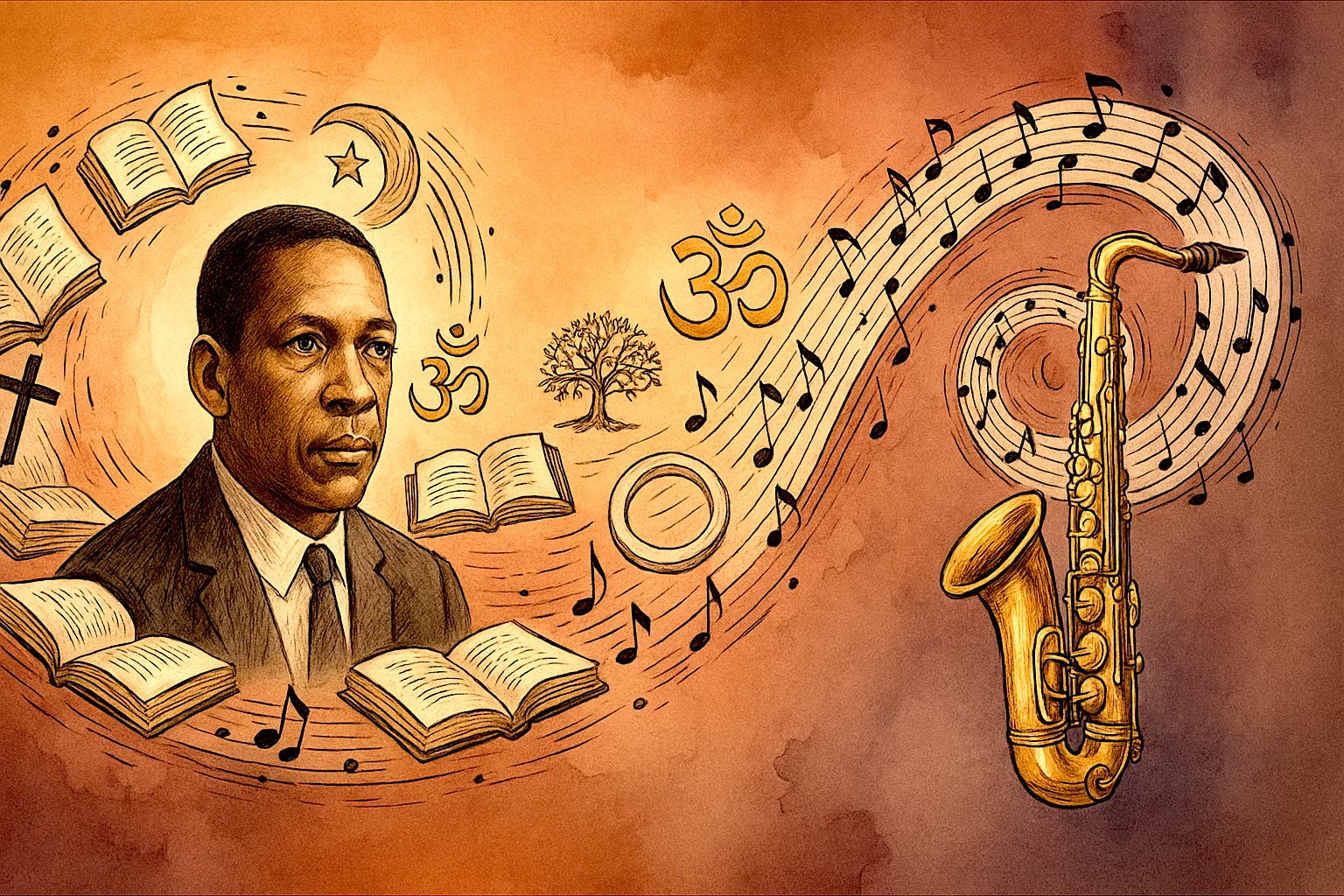
Following his 1957 awakening, Coltrane embarked on an extensive study of world religious and philosophical traditions. This wasn’t casual reading but a disciplined investigation that would consume him for the rest of his life. His library revealed this comprehensive quest: The Gospel of Sri Ramakrishna, the Bhagavad Gita, and Paramahansa Yogananda’s Autobiography of a Yogi introduced him to concepts of universal spirituality and divine realization through dedicated practice. These texts offered him a radically different framework from Western religious thought, one where direct experience of the divine was not only possible but expected through sustained spiritual discipline.
Yogananda’s autobiography proved particularly influential, becoming a constant companion that Coltrane returned to repeatedly. The book chronicles a search for universal truth that paralleled Coltrane’s own journey, documenting encounters with saints and sages who had achieved states of consciousness that Coltrane sought through his music. Yogananda’s vision of compatibility between Eastern and Western spiritual paths, noting similarities between Krishna and Christ, resonated deeply with Coltrane’s ecumenical sensibility. The yogi’s teaching that all religions were different paths to the same summit gave Coltrane permission to explore without abandoning his Christian roots, allowing him to see his Baptist upbringing as one valid approach among many rather than the sole path to truth.
This openness manifested in remarkable breadth that would have challenged trained theologians. Coltrane studied the Qur’an, the Bible, Kabbalah, and astrology with equal sincerity, seeking universal spiritual truth that transcended religious boundaries. He approached each text not as an academic exercise but as a practitioner seeking wisdom he could apply. His exploration of Kabbalah offered mystical frameworks for understanding the relationship between sound, consciousness, and divine reality. The Kabbalistic concept of creation through divine utterance particularly fascinated him, suggesting that sound itself possessed transformative spiritual power, an idea that would profoundly influence his approach to improvisation.
For a working musician maintaining a demanding performance schedule, often playing multiple sets nightly and traveling constantly, Coltrane’s intellectual appetite proved extraordinary. While other musicians relaxed between sets, Coltrane could be found backstage with a book, underlining passages and making notes in the margins. He absorbed Hinduism’s complex cosmology, Jiddu Krishnamurti’s radical teachings on freedom from tradition, African history that connected him to ancestral wisdom, Plato and Aristotle’s philosophy that provided logical frameworks for metaphysical questions, and Zen Buddhism’s paradoxical approach to enlightenment. These systematic studies provided intellectual scaffolding for his experiential spiritual practices, giving him vocabulary and concepts to understand what he was experiencing in his deepest moments of musical transcendence.
Contemporary spiritual teachers and movements also shaped his path, demonstrating that his quest wasn’t purely historical or theoretical. In 1966, John Glenn gave him Light on the Path, a slim volume on occultism inspired by Indian Buddhism, which Coltrane carried constantly, its pages worn from repeated reading. The book’s guidance on spiritual development through stages of initiation spoke to Coltrane’s sense of his own evolving consciousness. Alice Coltrane noted that John continued following Yogananda’s writings throughout their marriage, often discussing the guru’s teachings about cosmic consciousness and the unity of all existence. He cherished Gandhi’s works, finding in the Mahatma’s philosophy of non-violence and truth-force a political dimension to spiritual practice. He even explored Sonny Rollins’ insights about the Rosicrucians, an esoteric order claiming ancient wisdom about the nature of reality and human potential.
This eclectic approach reflected Coltrane’s conviction that truth emerged from many traditions, each offering pieces of a larger cosmic puzzle. Rather than seeing contradictions between different teachings, he sought underlying harmonies, believing that mystics of all traditions ultimately experienced the same ineffable reality. He prioritized direct spiritual experience over dogmatic adherence to any single system, creating a uniquely personal synthesis of global wisdom traditions. This synthesis wasn’t merely intellectual but lived, expressed through every note he played, making his saxophone a vehicle for the universal spirituality he discovered in his vast library of sacred texts.
At a panel discussion, host Bill T Jones asked, “Was Coltrane an academic?” Reggie Workman responded, “He was always reading. Does anyone here know about Joe Brazil? Joe Brazil had a car full of books that he brought to my school in Brooklyn.” Before recording “Om” Coltrane had been reading from Brazil’s 6 versions of the Bhavagad Gita.
This is great, thank you! Whilst of course the music speaks volumes for itself, I’m interested if he did any writings on these topics? (aside from love supreme liner notes)… maybe interviews also? I’m just so curious to hear how he distilled and articulated these ideas away from the instrument also